
I’ve just bought a new Canon 5D Mk3 DSLR camera, so this week has been an exciting one camera kit wise. I already have a Canon 1DX and now the Canon 5D Mk3 joins it.
Why the Canon 1D Mk4 had to go
I once had a Canon 1D Mk4 as my second camera. Although in some respects it is a better camera than the Canon 5D Mk3, the angle of view due to the sensor size made it difficult for me to use it effectively. As I mostly shoot weddings, I need to switch lenses quite quickly. The best way around this is to have two cameras so you always have two lenses ready. If however you have two cameras, each with a different angle of view (in the case of the Canon 1D Mk4, it was too narrow) it can create a problem. Having two cameras is also important due to potential camera failure at any time.
I much prefer to have two cameras that are very similar or the same. Having two Canon 1DX bodies would be a tad expensive, but it didn’t seem necessary anyway. The 5DMk3 is also full frame, has a few extra megapixels, a smaller form factor and a quieter silent shutter mode. It made more sense to get the 5DMk3 instead of the 1DX again.
Happily the Canon 1D Mk4 has found a new home with my friend Gary Evans at myeventphoto and is much better suited to his type of photography. It will likely be used for sports where a bit more reach is needed to get closer to the action.

In previous years I have tried a few different Canon cameras. I have always had a main camera and a backup. High prices have always been a stumbling block to buying identical main bodies, but I think now I am in the best position I have ever been.
Full frame good, focussing bad
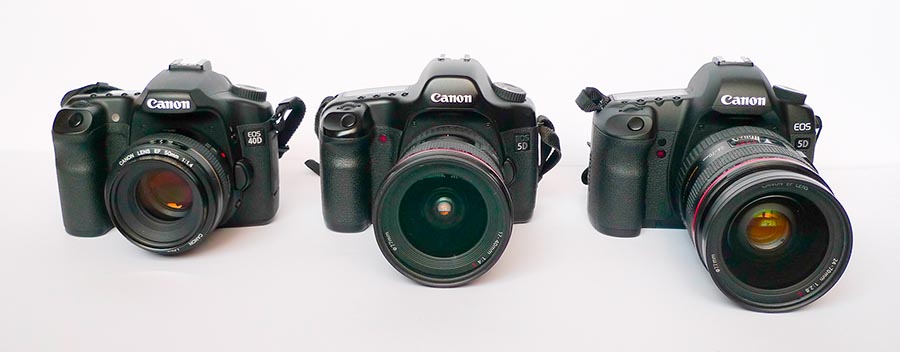
Below is the Canon 40D, the Canon 5D Mk1 and the Canon 5D Mk2. The 40D has a smaller sensor than the others so didn’t get as much use as I prefer full frame. Both the 5D Mk1 and 5D Mk2 got a lot of use at the time as they are both full frame and were at the time ahead of the competition in terms of image quality. They did however have an appalling focusing system, which made it very hard indeed for me to capture fleeting moments properly in focus. Quite honestly, as good as the pictures were that I got from them (with some effort!), I was very glad to see the back of them!! The Canon 1DX and Canon 5DMk3 are far more advanced cameras and give me excellent results MUCH more easily!
Using the Canon 5D Mk3 some years on
It’s now 2019 some years after buying my Canon 5D Mk3. I still use it all the time, now alongside a Canon 1D Mk2. I still think the 5D3 is an amazing camera, it offers (now) fantastic value for money as you can pick one up for a reasonable price second hand. I think the Canon 5D3 was about £3,000 when it first came out ( I got mine for about £1650 a while after its release).
The features that matter on the Canon 5D3
There were three features that basically had me sold on the 5D3, and that was the silent shutter mode, the focussing system being vastly improved, and the ability to assign different modes to the depth of field preview button. I have assigned mine to toggle between focus tracking on and off. This is incredibly useful when you suddenly have to get a photo of a bride walking, or someone running towards you. Or maybe an animal that starts moving. The ability to change this setting without having to remove the camera from you eye and look at an lcd display is the difference between getting a shot and missing it!
Struggling to keep up with a moving target was exactly the problem I was having with both the Canon 5D Mk1 and the Canon 5D Mk2. This was especially challenging when photographing the bride walking down the aisle.
I would previously have to preset the focus to continuous, and then pray that the camera would be able to see well enough in the dim lighting. And it is always dim, because if it were not dark enough in the church, just before the bride and groom start their walk down the aisle, the vicar usually invites the wedding guests to stand. This meant they blocked much of the light on the aisle and the bride and groom are now walking down a corridor of darkness!
The Canon 5D3 still struggles a little with dimly lit situations. However, the extra cross type points in its focussing system, and the ability to continuously focus more easily, means it’s a huge leap forward compared to its predecessor the 5D2.
The silent shutter mode
The 3rd of the features I mentioned; but of lesser importance, is the ‘silent shutter mode.’ I definitely wouldn’t call it ‘silent,’ that really is optimistic, but it is significantly quieter than standard. In fact I have the 5D3 permanently in silent shutter mode. I can’t see any benefit not too. I haven’t ever felt the camera was slow taking pictures as a result. I do a lot of photography for Millfield School; mostly of classical musical events. Having a quieter shutter is absolutely essential in this scenario, and quite honestly I don’t think I would be able to do this work at all without it!
Now of course we have mirrorless cameras which are becoming more commonplace. Sony, once a weak competitor to Canon and Nikon, now offers a compelling reason to switch. But I am holding onto my Canons for now. I have way too much investment in Canon professional L lenses and though Canon are somewhat late to the party with mirrorless cameras, I can hold out for a bit before I switch to mirrorless cameras.
At the end of the day, the most important factor in photography is the person behind the lens. I could complain I don’t have the right gear or that I don’t live in an area full of mountains or exciting things going on, but those are just excuses. The person using the camera, whether it be a point and shoot, a smartphone or a Canon 5D Mk3 is the most important factor. The person is who has the vision and the ideas, not a box of circuitboards.